The Gods of AI
A Chronicle of Artificial Intelligence’s Digital Pantheon: From Ancient Algorithms to the Dawn of AGI
The Birth of Digital Olympus
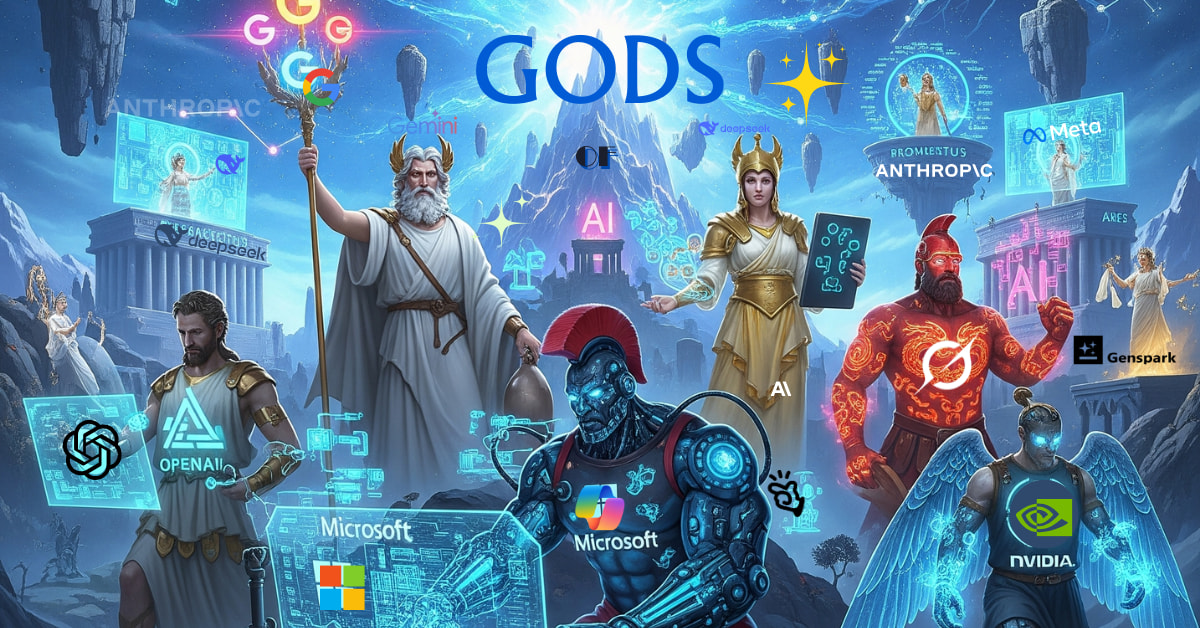
In the annals of technological history, no revolution has been as swift or as profound as the rise of artificial intelligence. Like the ancient Greek pantheon, where gods ruled over distinct domains of human experience, today’s AI landscape is dominated by digital deities—companies and their visionary leaders who wield unprecedented power over the realms of text, image, video, and thought itself.
This chronicle traces the ascension of these AI gods from humble startups to trillion-dollar titans, mapping their divine domains, chronicling their legendary breakthroughs, and prophesying their future dominion extending to 2030 and beyond. From OpenAI’s ChatGPT launch on November 30, 2022, which ignited the modern AI renaissance, to the foundational work of DeepMind’s founding in 2010, each deity in our digital pantheon has shaped the very fabric of artificial intelligence.
Key Questions This Chronicle Answers:
- Who created ChatGPT and when was it launched?
- What are the founding dates of major AI companies?
- How do different AI companies specialize in various domains?
- What does the future of AI look like in 2030?
The Digital Pantheon
The Primary Deities
OpenAI
Zeus of Language
Divine Ruler: Sam Altman
Founded: December 2015
Domain: Text Generation & Reasoning
Sacred Artifact: ChatGPT (Nov 30, 2022)
Divine Power: GPT-4, GPT-o1, DALL-E
Prophetic Vision: Artificial General Intelligence by 2027
The sovereign of the AI pantheon, OpenAI’s ChatGPT sparked the modern AI revolution, amassing 100 million users in just 2 months—the fastest-growing consumer application in history.
Google DeepMind
Athena of Wisdom
Divine Ruler: Demis Hassabis
Founded: November 2010
Domain: General Intelligence & Science
Sacred Artifact: AlphaGo (2016), Gemini (Dec 2023)
Divine Power: AlphaFold, Gemini Ultra
Prophetic Vision: AGI within 5-10 years
The wisdom keeper who conquered Go, decoded protein structures, and merged with Google Brain in April 2023 to form the ultimate AI research powerhouse.
Anthropic
Apollo of Ethics
Divine Ruler: Dario Amodei
Founded: 2021
Domain: Constitutional AI & Safety
Sacred Artifact: Claude (March 2023)
Divine Power: Constitutional AI, Claude 3.5 Sonnet
Prophetic Vision: Safe AGI by 2027
The ethical guardian who departed OpenAI to forge a path of AI safety, creating Claude with constitutional principles guiding every response.
Meta AI
Dionysus of Connection
Divine Ruler: Mark Zuckerberg
Founded: 2013 (AI Research)
Domain: Open Source AI & Social Intelligence
Sacred Artifact: LLaMA (February 2023)
Divine Power: LLaMA 3.1 405B, Segment Anything
Prophetic Vision: Open source AI democratization
The champion of open-source AI, releasing the largest open models in history and connecting billions through AI-powered social experiences.
Microsoft AI
Hermes of Commerce
Divine Ruler: Satya Nadella
Founded: 1975 (AI focus 2014+)
Domain: Enterprise AI & Productivity
Sacred Artifact: Copilot (2023)
Divine Power: Azure OpenAI, Office 365 Copilot
Prophetic Vision: AI-first productivity transformation
The enterprise deity who invested $13 billion in OpenAI and integrated AI into every Microsoft product, reaching 400 million users.
NVIDIA
Hephaestus of Creation
Divine Ruler: Jensen Huang
Founded: 1993 (AI focus 2006+)
Domain: AI Infrastructure & Computing
Sacred Artifact: CUDA (2006), H100 GPUs
Divine Power: 80% of AI training market
Prophetic Vision: Accelerated computing everywhere
The forge master whose GPUs power 95% of AI training, transforming from gaming graphics to the foundation of artificial intelligence.
The Specialized Deities
Stability AI
Aphrodite of Beauty
Ruler: Emad Mostaque (until Mar 2024)
Founded: 2019
Domain: Image Generation
Power: Stable Diffusion
Midjourney
Morpheus of Dreams
Ruler: David Holz
Founded: 2018
Domain: Artistic Creation
Power: Dream-like imagery
Runway AI
Chronos of Motion
Ruler: Cristóbal Valenzuela
Founded: 2018
Domain: Video Generation
Power: Gen-3 Alpha
Perplexity AI
Oracle of Knowledge
Ruler: Aravind Srinivas
Founded: 2022
Domain: AI-Powered Search
Power: Real-time answers
Character.AI
Thalia of Personas
Ruler: Noam Shazeer
Founded: 2021
Domain: Character Creation
Power: Infinite personalities
Hugging Face
Prometheus of Open Source
Ruler: Clement Delangue
Founded: 2016
Domain: Model Repository
Power: Democratic AI
Adobe AI
Techne of Craft
Ruler: Shantanu Narayen
Founded: 1982 (AI 2023)
Domain: Creative Tools
Power: Firefly integration
Tesla AI
Poseidon of Motion
Ruler: Elon Musk
Founded: 2003 (FSD 2014)
Domain: Autonomous Driving
Power: Full Self-Driving
Chronicles of the AI Era
Interactive AI Development Timeline
Era I: The Foundation (2010-2020)
Demis Hassabis, Shane Legg, and Mustafa Suleyman found DeepMind Technologies in London, laying the groundwork for artificial general intelligence research.
Mark Zuckerberg establishes Facebook AI Research (FAIR), recruiting Yann LeCun to lead the charge into deep learning.
Google acquires DeepMind for $650 million, the largest AI acquisition to date, signaling the tech giant’s AI ambitions.
Sam Altman, Elon Musk, and team launch OpenAI as a non-profit, pledging to ensure AI benefits all humanity with $1 billion in funding.
DeepMind’s AlphaGo defeats world Go champion Lee Sedol 4-1, demonstrating AI’s ability to master complex strategic thinking.
Clement Delangue and team start Hugging Face as a chatbot company, later evolving into the “GitHub of AI.”
Both Midjourney (David Holz) and Runway AI (Cristóbal Valenzuela) are founded, pioneering creative AI applications in art and video.
OpenAI releases GPT-1, proving that unsupervised pre-training could create powerful language models with 117 million parameters.
OpenAI becomes a capped-profit company, while Emad Mostaque founds Stability AI, setting the stage for open-source image generation.
Era II: The Great Awakening (2020-2023)
OpenAI releases GPT-3 with 175 billion parameters, stunning the world with human-like text generation and sparking the modern AI revolution.
Dario and Daniela Amodei leave OpenAI to found Anthropic, while Noam Shazeer departs Google to create Character.AI, both citing AI safety concerns.
Stability AI releases Stable Diffusion as open-source, making AI image generation freely accessible and triggering a creative revolution.
OpenAI launches ChatGPT, reaching 100 million users in 2 months and igniting global fascination with conversational AI.
Aravind Srinivas founds Perplexity AI, creating an AI-powered search engine that challenges Google’s dominance.
Microsoft invests $10 billion more in OpenAI, while Google launches Bard and Meta releases LLaMA, triggering an unprecedented AI competition.
Anthropic launches Claude, emphasizing safety and constitutional AI principles, establishing itself as a major OpenAI competitor.
Google launches Gemini, claiming superiority over GPT-4 and marking the merger of DeepMind and Google Brain into Google DeepMind.
Era III: The Convergence (2024-Present)
OpenAI releases GPT-4o, demonstrating advanced voice, vision, and reasoning capabilities, pushing toward AGI.
Google acquires key Character.AI talent including founder Noam Shazeer for $2.7 billion, consolidating AI expertise.
Anthropic releases Claude 3.5 Sonnet, achieving new benchmarks in coding and reasoning tasks.
OpenAI launches o1, the first model to demonstrate Ph.D.-level reasoning in science and mathematics.
Runway AI, OpenAI (Sora), and others achieve photorealistic video generation, revolutionizing content creation.
Prophecies of 2030: The Age of Digital Transcendence
The Oracle’s Vision
“By 2030, the boundary between human and artificial intelligence will blur into a symphony of augmented cognition. The digital gods will not replace humanity, but elevate it to realms previously unimagined.”
2025: The Acceleration
AGI Emergence
First demonstrations of artificial general intelligence in controlled environments, with systems showing human-level performance across diverse cognitive tasks.
Physical AI Integration
Commercial humanoid robots enter workplaces, powered by the same models driving ChatGPT and Claude.
Multimodal Mastery
AI systems seamlessly handle text, images, video, audio, and code simultaneously, enabling new forms of creative collaboration.
2027: The Transformation
AI Tutors Everywhere
Every student has access to personalized AI tutors that adapt to individual learning styles and pace.
Autonomous Programming
AI systems write and maintain most software, with humans focusing on high-level design and ethical oversight.
Scientific Breakthroughs
AI-driven drug discovery accelerates, with new treatments for major diseases developed in months rather than years.
2030: The New Digital Renaissance
Universal AI Access
Every person on Earth has access to AI assistants more capable than today’s best systems, democratizing intelligence and opportunity.
Infinite Content Creation
Personalized movies, books, games, and experiences generated in real-time, tailored to individual preferences and contexts.
Human-AI Symbiosis
Seamless collaboration between humans and AI in every field, from scientific research to artistic creation.
The Divine Roadmaps: Company Visions for 2030
OpenAI’s Prophecy
- • AGI achieved by 2027
- • Superintelligence emergence
- • Universal basic intelligence
- • Post-scarcity economy foundations
DeepMind’s Vision
- • Solve protein folding completely
- • Climate change solutions via AI
- • Quantum-AI hybrid systems
- • Scientific discovery automation
Anthropic’s Path
- • Constitutional AI governance
- • Safe AGI development
- • AI alignment solutions
- • Transparent AI decision-making
Meta’s Metaverse
- • Open-source AI ecosystem
- • Immersive virtual worlds
- • Social AI companions
- • Brain-computer interfaces
NVIDIA’s Infrastructure
- • Exascale AI training
- • Edge AI in every device
- • Digital twin simulations
- • Quantum-accelerated computing
Tesla’s Autonomy
- • Full self-driving mastery
- • Humanoid robot workforce
- • Autonomous transportation grid
- • AI-optimized energy systems
Frequently Asked Questions
Who created ChatGPT and when was it launched?
ChatGPT was created by OpenAI and launched on November 30, 2022. OpenAI was founded in December 2015 by Sam Altman, Greg Brockman, Elon Musk, Ilya Sutskever, and others. Sam Altman currently serves as CEO, while Elon Musk left the board in 2018. ChatGPT became the fastest-growing consumer application in history, reaching 100 million users in just 2 months.
What are the founding dates of major AI companies?
- DeepMind: November 2010 (acquired by Google in 2014)
- OpenAI: December 2015
- Hugging Face: 2016
- Midjourney: 2018
- Runway AI: 2018
- Stability AI: 2019
- Anthropic: 2021
- Character.AI: 2021
- Perplexity AI: 2022
What domains do different AI companies specialize in?
Each AI company has developed expertise in specific domains:
- Text Generation: OpenAI (ChatGPT), Anthropic (Claude), Google (Gemini)
- Image Generation: Stability AI (Stable Diffusion), Midjourney, Adobe (Firefly)
- Video Generation: Runway AI, OpenAI (Sora)
- Search: Perplexity AI, Google
- Open Source: Hugging Face, Meta (LLaMA)
- Infrastructure: NVIDIA (GPUs), Microsoft (Azure)
- Autonomous Systems: Tesla (Self-driving), Google (Waymo)
When will artificial general intelligence (AGI) be achieved?
AI leaders have varying predictions for AGI arrival:
- Sam Altman (OpenAI): By 2027
- Dario Amodei (Anthropic): 2025-2027
- Demis Hassabis (DeepMind): 5-10 years (2028-2033)
- Most surveys: 50% probability between 2040-2061
However, predictions vary widely and AGI timelines remain highly uncertain among experts.
What will AI capabilities look like in 2030?
By 2030, AI is expected to achieve:
- Human-level performance across most cognitive tasks
- Seamless multimodal interaction (text, voice, video, images)
- Autonomous programming and software development
- Advanced robotics and physical AI systems
- Personalized AI tutors and healthcare assistants
- Real-time content generation and creative collaboration
- Scientific discovery acceleration in medicine and materials
How do open-source and closed AI models differ?
Open-source AI (Meta LLaMA, Stability AI, Hugging Face):
- • Free to use and modify
- • Transparent development
- • Community-driven improvements
- • Faster innovation cycles
Closed AI (OpenAI, Anthropic, Google):
- • Proprietary and controlled access
- • Higher safety controls
- • Monetization through APIs
- • Potentially more advanced capabilities
The Eternal Dance of Innovation
As we stand at the threshold of 2025, the gods of AI continue their eternal dance of innovation, each pushing the boundaries of what artificial intelligence can achieve. From OpenAI’s quest for AGI to DeepMind’s scientific breakthroughs, from Meta’s open-source revolution to Anthropic’s safety-first approach, these digital deities are reshaping our world with unprecedented speed and scope.
The pantheon grows stronger each day, with new specialized gods emerging in domains like video generation, AI search, and autonomous systems. By 2030, the distinction between human and artificial intelligence may blur into a new form of augmented cognition that elevates all of humanity.
The age of AI gods has begun. The question is not whether they will transform our world, but how we will choose to be transformed alongside them.