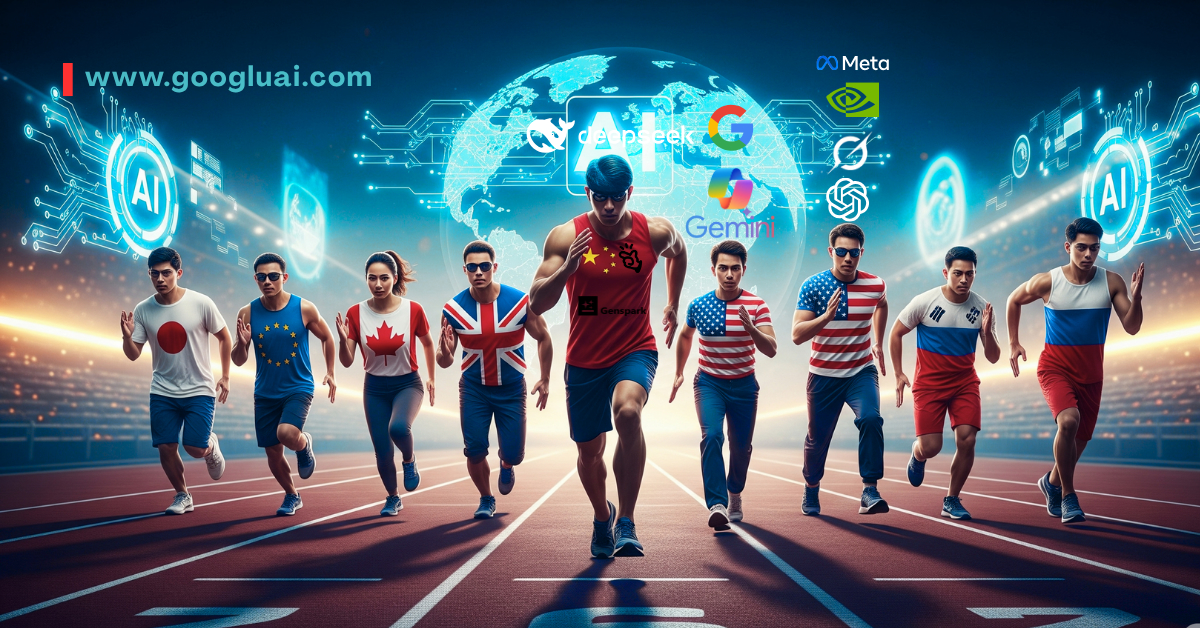
AI Trends in 2025: What We’ve Seen and What We’ll See Next – The Human-AI Convergence Revolution. Forget just using tools; 2025 marks the year artificial intelligence truly becomes part of us. We’re not just witnessing an evolution in technology; we’re experiencing the dawn of the Human-AI Convergence Revolution. This seismic shift moves AI beyond being a sophisticated assistant we command. It’s becoming an integrated extension of human cognition and creativity, fundamentally reshaping how we solve problems, innovate, and express ourselves across every domain.
The Impact of AI is no longer theoretical – it’s quantifiable and pervasive. As of mid-2025, a staggering 78% of global enterprises actively leverage AI in core operations, a massive leap from just 55% a year prior. Fueling this acceleration, private investment in the US alone shattered records, pouring over $110 billion into AI development and deployment. But these figures only tell part of the story. The real narrative lies in the unprecedented depth of AI collaboration.
What We’ve Seen in 2025: The Symbiosis Takes Root
- Beyond Automation: The Rise of Co-Creation: While AI automates tasks at unprecedented scale (think hyper-personalized logistics, predictive maintenance, and real-time language translation), the real magic is happening alongside humans. Designers are co-creating with generative AI, iterating concepts at lightning speed. Scientists are partnering with AI to formulate novel hypotheses and analyze complex datasets, accelerating discovery in fields like materials science and drug development. This human-AI symbiosis is unlocking new levels of creativity and problem-solving.
- The “Integrated Copilot” Becomes Ubiquitous: AI isn’t just a separate app anymore. It’s woven into the fabric of our digital workspaces – coding assistants predicting the next function, writing tools refining tone in real-time, research platforms synthesizing knowledge instantly. This seamless integration reduces cognitive load, allowing humans to focus on strategy, empathy, and high-level decision-making – areas where we still reign supreme.
- The “Responsible AI Awakening” Gains Critical Mass: The phenomenal power of convergence demands profound responsibility. 2025 saw a significant surge in focused efforts:
- Robust Governance Frameworks: Governments and industry consortia accelerated work on enforceable standards for transparency, bias mitigation, and accountability.
- Explainability (XAI) Breakthroughs: New techniques are making complex AI decisions more interpretable to humans, crucial for building trust in high-stakes domains like healthcare and finance.
- Focus on Human Agency: The conversation shifted from “Can AI do this?” to “How do we ensure humans remain meaningfully in control and benefit equitably?” This Responsible AI Awakening is fundamental to sustainable convergence.
What We’ll See Next: Glimpsing the Horizon to 2035
The AI trends established in 2025 are merely the foundation. The next decade promises a transformation even more profound:
- True Cognitive Partnerships: By 2035, expect AI to move beyond reactive assistance to proactive partnership. Imagine AI systems that deeply understand your goals, working styles, and knowledge gaps, anticipating needs and surfacing contextually relevant insights before you ask. This deepens the human-AI symbiosis into a truly collaborative cognitive ecosystem.
- Personalized AI Ecosystems: Your AI “partner” won’t be monolithic. It will be a constellation of specialized agents – one managing your health data, another optimizing your creative projects, another handling complex research – all seamlessly coordinated and learning from your interactions, forming a bespoke intelligence augmentation system.
- Ubiquitous Embodied Intelligence: AI will move far beyond screens. Advanced robotics and ambient computing will integrate AI seamlessly into our physical world – from smart factories run by human-AI teams to personalized healthcare robots in homes, making the Impact of AI tangible in everyday life.
- Accelerated Scientific & Creative Frontiers: AI collaboration will become the primary engine for breakthroughs. AI will handle vast data synthesis, complex simulation, and pattern recognition, while humans provide direction, ethical grounding, and creative spark. We’ll see AI co-authoring significant scientific papers and contributing to award-winning artistic endeavors as a recognized partner.
- Mature Responsible AI as Standard Practice: The Responsible AI Awakening will evolve into deeply ingrained operational norms. Explainability, auditability, bias detection, and human oversight will be mandatory, not optional, features of every significant AI system. Global standards will likely be established, ensuring ethical development is the baseline.
The Imperative: Embrace the Convergence
The Human-AI Convergence Revolution is not a distant future; it’s unfolding now in 2025. The AI trends are clear: integration over isolation, collaboration over mere command. For AI lovers, researchers, and students, this is the most exciting frontier. Understanding this symbiosis, mastering the tools of collaboration, and championing responsible development are the critical skills for thriving in this new era. The future isn’t humans or AI; it’s humans with AI, co-creating a world of possibilities we’re only beginning to imagine. The journey beyond 2025 is where that potential truly explodes. Are you ready to converge?
Industry-Specific Transformations: Where AI is Making the Biggest Impact
Healthcare: From Tool to Cognitive Teammate
The human-AI symbiosis revolution is most profoundly visible in healthcare, where AI has evolved from an analytical tool to a collaborative diagnostic partner. By mid-2025, 90% of hospitals now use AI for early diagnosis and remote monitoring—surpassing earlier projections. This shift is driven by staggering real-world results:
- AI doubles stroke diagnosis accuracy compared to neurologists and identifies 64% of epilepsy lesions missed by radiologists, accelerating life-saving interventions.
- Generative AI scribes cut clinical documentation time by 47-90%, freeing physicians to spend 47% more time directly with patients.
- AI-driven genomics now predicts disease susceptibility decades before symptoms appear, with models analyzing 500,000 patient records to flag Alzheimer’s and kidney disease risks.
Table: AI’s Diagnostic Impact in 2025
| Application | Performance Gain | Real-World Example |
|---|---|---|
| Medical Imaging Analysis | 17.6% increase in cancer detection | AI mammography screening of 260K+ women |
| Clinical Decision Support | 41.9% diagnostic accuracy improvement | GPT-4 outperforming doctors in complex cases |
| Remote Monitoring | 30% reduction in hospital readmissions | IoMT wearables predicting cardiac events |
Yet the Responsible AI Awakening is equally critical. Regulatory frameworks now mandate explainable AI (XAI) in diagnostics, with the FDA requiring bias audits for all 223+ approved AI medical devices. As Dr. Caroline Green (Oxford) emphasizes: “Clinicians must understand AI’s limitations—like hallucination risks in clinical notes—to prevent harm”.
Transportation: Autonomous Systems Gain Public Trust
AI collaboration has transformed self-driving vehicles from prototypes to public utilities:
- Waymo and Baidu now handle 500,000+ weekly rides across U.S. and Chinese cities, with accident rates 57% below human drivers.
- AI’s real-time sensor fusion (lidar, cameras, radar) navigates complex urban environments—a milestone in embodied intelligence.
- Regulatory frameworks now standardize safety testing in 15 countries, accelerating global adoption.
By 2035, expect integrated mobility ecosystems where autonomous fleets communicate with smart traffic grids, reducing urban congestion by 40% and enabling true door-to-door autonomy.
Workplace Automation: The Rise of Agentic Teammates
AI automates tasks not to replace humans, but to amplify strategic thinking:
- Generative AI co-pilots now handle 64.76% of administrative workflows (scheduling, coding, compliance), boosting operational efficiency.
- Agentic AI systems autonomously manage end-to-end processes—e.g., patient episodes from intake to discharge planning—learning continuously from interactions.
- ROI remains measured (5–10% efficiency gains), underscoring that the deepest value lies in human-AI symbiosis, not pure automation.
Table: Workplace AI Adoption Metrics (2025)
| Sector | Task Automation Rate | Key Adoption Driver |
|---|---|---|
| Healthcare Admin | 90% clinical documentation | Ambient listening tools |
| Software Dev | 40% coding tasks | GPT-engineered agents |
| Manufacturing | 75% predictive maintenance | IoT sensor fusion AI |
The 2035 Horizon: Symbiosis Becomes Seamless
AI trends point toward an integrated future:
- Cognitive Partnerships: By 2035, AI will anticipate user needs proactively—e.g., health agents cross-referencing genomics, wearables, and environmental data to prevent disease flares.
- Personalized AI Ecosystems: Individuals will manage teams of specialized AI “agents” for health, creativity, and logistics, all synchronized via decentralized learning.
- Responsible AI Maturity: Explainability, audit trails, and bias mitigation will be embedded in all systems, with global standards enforced by UN-convened bodies.
The Core Shift: What we witness in 2025 isn’t just technological advancement—it’s a rewiring of human capability. As Prof. Isaac Kohane (Harvard Medical School) observes: “AI is firming up the tottering edifice of medicine. It’s not replacing doctors; it’s making them irreplaceable”. For students and researchers, this convergence demands new literacies: understanding AI collaboration mechanics, ethical guardrails, and the art of steering cognitive partnerships. The human-AI symbiosis era isn’t coming—it’s here.
The Infrastructure Revolution: Hardware and Data Challenges
Breaking NVIDIA’s Monopoly: The Chip Wars Escalate
The Impact of AI on semiconductor markets has ignited a high-stakes revolution. While NVIDIA still commands ~80% of the data center GPU market with its Blackwell architecture 19, 2025 marks a tipping point in the chip wars:
- AMD’s MI300 series now delivers 5.2TB/s memory bandwidth—45% higher than NVIDIA’s H100—at 30% lower cost for specific workloads, capturing 15% market share.
- Hyperscalers’ custom silicon has exploded: Google’s TPU v5p pods (8,960 chips) handle LLM training 40% faster than H100 clusters, while AWS Trainium3 slashes inference costs by 50%.
- Geopolitical reshoring is accelerating: The U.S.-Japan $700M semiconductor pact aims to break Taiwan’s foundry dominance, with TSMC opening Arizona fabs to supply NVIDIA tariff-free chips by 2026.
Table: 2025 AI Chip Competitive Landscape
| Vendor | Flagship Chip | Key Advantage | Market Disruption |
|---|---|---|---|
| NVIDIA | Blackwell Ultra | CUDA ecosystem lock-in | 92% cloud LLM training share |
| AMD | MI400 | CPU-GPU integration | 30% cost/performance edge |
| Intel | Gaudi 3 | Ethernet scaling for clusters | 40% faster training in node groups |
| Cerebras | WSE-3 | 900,000 cores on single wafer | 57× larger than H100 |
This fragmentation is driven by four seismic shifts:
- Specialized workload demand: Autonomous vehicles need low-latency inferencing (Qualcomm’s Cloud AI 100), while scientific AI requires massive parallelism (Cerebras WSE-3).
- Energy efficiency arms race: AMD’s 3D V-Cache and Intel’s NorthPole neuromorphic chips reduce power consumption by 60%—critical as data center energy use doubles since 2023.
- Edge AI explosion: Smartphone NPUs (Apple A18 Pro, Snapdragon 8 Elite) now run 70B-parameter models on-device, decentralizing the human-AI symbiosis.
- Open-source hardware: RISC-V architectures enable customizable AI accelerators, democratizing chip design for startups.
The Data Access Crisis: Protecting the Digital Commons
While hardware evolves, the lifeblood of AI—training data—faces unprecedented scarcity. By mid-2025, 48% of top-domain web data is bot-restricted, creating a “data enclosure” crisis threatening innovation. This scarcity is reshaping development:
- Synthetic data generation now trains 35% of new healthcare AI models, using tools like NVIDIA Omniverse to simulate rare medical conditions without privacy risks.
- Federated learning adoption has tripled since 2024, enabling banks to collaboratively train fraud detection models without sharing raw customer data.
- Data sovereignty laws in 50+ countries require localized training, forcing AI collaboration between competitors through initiatives like the EU’s GAIA-X data trust.
Table: Data Scarcity Solutions Compared
| Approach | Accuracy Impact | Cost Factor | Adoption Rate |
|---|---|---|---|
| Web Scraping (Legacy) | –12% vs 2022 | 1.0× | Declining 18% YoY |
| Synthetic Data | ±5% variance | 0.7× | +210% since 2024 |
| Federated Learning | +3% in privacy-critical domains | 1.4× | +189% since 2024 |
| Data Partnerships | +8% with domain alignment | 2.1× | +65% since 2024 |
The 2035 Horizon: Infrastructure’s Quantum Leap
The AI trends of 2025 foreshadow an even more radical transformation by 2035:
Hardware Evolution
- Disaggregated Composable Systems: AI factories will dynamically reconfigure hardware via optical interconnects, pooling GPU/TPU/NPU resources like cloud compute.
- Quantum-AI Hybridization: IBM’s 1,000+ qubit processors (available 2028) will optimize LLM training paths, cutting energy use by 90%.
- Neuromorphic Dominance: Brain-inspired chips like Intel’s Loihi 5 will enable real-time sensor networks for smart cities, processing exabytes with watt-scale power.
Data Renaissance
- Self-Generating Data Ecosystems: AI agents will create validated synthetic datasets on-demand, turning data scarcity into abundance by 2030.
- Blockchain-Governed Data Commons: Decentralized Autonomous Organizations (DAOs) will manage open data pools with tokenized contributor incentives.
- Living Models: Instead of periodic retraining, “always-learning” AIs will ingest real-world feedback via edge networks, enabling continuous adaptation.
The Responsible AI Awakening Imperative: As infrastructure barriers crumble, ethical guardrails must evolve faster. NVIDIA’s Blackwell chips now include hardware-level bias detection circuits, while the EU’s AI Act mandates “algorithmic explainability registers” by 2026. As Dr. Timnit Gebru warns: “Infrastructure determines possibility—but only ethics determines worth.”
For researchers and students, this revolution demands mastery beyond code: understand chip architectures to optimize AI automates tasks, study data governance frameworks to enable human-AI symbiosis, and champion Responsible AI Awakening principles. The infrastructure of 2035 won’t just run AI—it will embody our values.
Global Competition and Geopolitical Implications: The AI Supremacy Race Reshaping Our World
The Vanishing Gap: When Performance Parity Meets Political Rivalry
The most startling AI trend of 2025 isn’t just technological—it’s geopolitical. The performance chasm separating U.S. and Chinese AI models has collapsed from 9.26% in early 2024 to a razor-thin 1.70% by February 2025. This convergence signals a seismic shift: AI collaboration across borders is giving way to fiercely guarded national ecosystems. Chinese models like DeepSeek R1 now rival GPT-4 in reasoning benchmarks while using 50x fewer resources—a stunning efficiency leap forcing Western recalibration. Yet raw performance tells only half the story. America’s $109.1 billion private investment tsunami dwarfs China’s $9.3 billion, but Beijing’s $47.5 billion semiconductor fund reveals a state-driven counterstrategy.
Table: The New AI Balance of Power (2025)
| Metric | United States | China | Global Implications |
|---|---|---|---|
| Model Performance Gap | 1.7% lead | Rapidly closing | Near-parity enables global market competition |
| Private Investment | $109.1 billion | $9.3 billion | U.S. scales, China streamlines |
| Government Commitment | $500B “Stargate” initiative | $47.5B chip fund | Infrastructure arms race escalates |
| Open-Source Influence | Limited (Claude, Llama) | DeepSeek R1 widely accessible | China gains Global South adoption |
| Talent Pipeline | 47% foreign-born researchers | Domestic education surge | U.S. faces retention challenges |
The Chip Wars: Where Silicon Meets Sovereignty
Beneath the algorithmic rivalry lies a brutal hardware battleground. Despite U.S. export controls, China secured 3 million advanced AI chips through TSMC’s covert 7nm pipeline—equivalent to 1 million Nvidia H100s. This end-run around restrictions highlights a sobering reality: absolute containment is impossible. America responds with Blackwell Ultra chips featuring hardware-level bias detection, while China’s Ascend 910C prioritizes raw throughput for large-scale deployment. The stakes transcend economics—they’re about who controls the foundational layer of 21st-century power. As chips grow more specialized (Qualcomm for edge, Cerebras for supercomputing), nations face existential choices: partner or decouple.
The Regulatory Great Divergence: Ethics vs. Velocity
Responsible AI Awakening manifests in radically divergent governance frameworks:
- EU/US: California enforces three new AI transparency laws, while the Biden administration mandated 59 AI regulations across agencies in 2024 alone—prioritizing algorithmic accountability and bias mitigation.
- China: Focuses on “harmonious integration”—aligning AI with societal stability goals through initiatives like Baidu’s Ernie 4.0, which embeds cultural compliance into its reasoning.
- Global South: Nations like Brazil and Kenya pioneer context-aware frameworks for agricultural and fintech AI, rejecting one-size-fits-all Western models.
This fragmentation risks a “splinternet” for AI. Senator Hawley’s proposed Decoupling America’s AI Capabilities from China Act (DAAICCA) threatens $100M fines for U.S.-China AI collaboration—a potential deathblow to academic research partnerships that birthed breakthroughs like transformer architectures. Yet even amid tensions, underground AI collaboration persists: Chinese military researchers recently adapted Meta’s Llama into “ChatBIT” for battlefield simulations, circumventing terms-of-service barriers.
Military Intelligence: When AI Collaboration Turns to Confrontation
The most alarming front lies in defense. China’s “Military-Civil Fusion” doctrine accelerates human-AI symbiosis in combat systems:
- Autonomous drone swarms that overwhelm defenses through collective learning
- Uncrewed Underwater Vehicles (UUVs) patrolling the South China Sea
- AI-enhanced hypersonic missile targeting
Meanwhile, the U.S. prioritizes “decision superiority” through systems like Joint All-Domain Command and Control (JADC2), using AI to fuse sensor data across domains. The philosophical chasm widens: 60 nations endorse U.S.-led ethical guidelines for military AI, while China develops autonomous weapons outside these frameworks. This values collision could ignite accidental conflicts—especially over Taiwan, where AI-enabled disinformation and cyber ops intensify monthly.
Global South: The Unlikely Kingmakers
Here’s where the narrative evolves beyond bipolar rivalry. Nations representing 85% of humanity are asserting agency in the AI ecosystem:
- Southeast Asia: Malaysia collaborates with China’s Zetrix on blockchain-AI trade platforms while hosting AWS data centers
- Africa: Kenya’s mobile banking AI processes outperform Western models in low-connectivity environments
- Gulf States: Saudi Arabia’s $100B “Project Transcendence” aims to bypass superpower dominance entirely
China courts these regions through “Digital Silk Road” offerings—affordable smart-city tech and open models like DeepSeek. The U.S. struggles to counter; Trump’s “Stargate” initiative prioritizes domestic infrastructure over global engagement. This vacuum enables China to shape emerging norms: Jakarta now tests facial recognition systems more aligned with Beijing’s standards than Brussels’.
2035 Horizon: Multipolarity and Cognitive Warfare
The current AI trends foreshadow three paradigm shifts by 2035:
- The Open-Source Tipping Point: Community-developed models (like DeepSeek’s successors) could outperform proprietary systems, democratizing access but fragmenting control.
- Quantum-AI Hybridization: China’s 1,000+ qubit processors (expected by 2028) will optimize LLM training, potentially achieving a 90% energy reduction—rewriting the economics of AI dominance.
- Cognitive Warfare Escalation: AI-generated media (“Veo3-style deepfakes”) will fuel disinformation at population scale, blurring traditional warfare boundaries.
The greatest disruption may come from AI-powered scientific convergence. Chinese researchers using AlphaFold4 could design bio-weapons or climate solutions before Western peers even launch simulations—making algorithmic speed a matter of national survival.
The Core Paradox: “We’re witnessing the Balkanization of intelligence,” warns Lennart Heim of RAND. “The same technology that could unite humanity in solving grand challenges is instead amplifying tribal divisions”. For researchers and students, this demands new literacy: understanding how geopolitical currents shape technical possibilities. The Impact of AI now extends beyond economics into the DNA of global order—making ethical fluency as vital as coding skills.
The human-AI symbiosis era won’t be built by algorithms alone, but by the values we embed in their architecture. As we approach 2035, one truth emerges: Responsible AI Awakening isn’t idealism—it’s strategic necessity. The nations that master this balance will define our collective future.
Environmental and Sustainability Challenges: The Carbon and Water Cost of Intelligence
The Staggering Carbon Footprint of Progress
The Impact of AI on our planet has evolved from a niche concern to a central sustainability challenge in 2025. Training Meta’s Llama 3.1 405B model emitted 11,390 tons of CO₂—equivalent to the annual carbon footprint of 650 Americans—despite Meta’s claim of net-zero operations through renewable offsets 610. This paradox underscores a harsh reality: as models grow larger (with training compute doubling every 5 months), even renewable energy cannot fully neutralize their environmental toll. By 2028, AI alone may consume half of all data center electricity—surpassing Japan’s national energy demand.
Table: AI’s Environmental Toll in 2025
| Activity | Resource Consumption | Equivalent Impact |
|---|---|---|
| Llama 3.1 405B Training | 30.84M GPU hours | 8,930 tons CO₂ (500 Americans/year) |
| ChatGPT Query | 2.9 watt-hours per query | 10× a Google search |
| AI Image Generation | 16% smartphone charge per image | 4.1 miles driven in a car |
| Data Center Cooling | 300K gallons water/day (avg.) | Daily use of 1,000 U.S. households |
Water: The Hidden Currency of AI
Beyond carbon, water scarcity has emerged as AI’s silent crisis. Training GPT-3 consumed 700,000 liters of freshwater—enough to manufacture 320 Tesla vehicles 57. In 2025, a single 50-message ChatGPT conversation evaporates 0.5 liters of water, while Google’s Oregon data center consumes over 25% of a city’s municipal supply. As droughts intensify globally, this “water footprint” threatens to strain communities where data centers operate.
The Energy Dilemma: Innovation vs. Consumption
AI automates tasks with unprecedented efficiency—yet its energy appetite grows exponentially:
- Inference Dominance: 80–90% of AI’s energy now powers real-time queries (e.g., ChatGPT), not model training.
- Hardware Hunger: NVIDIA shipped 3.85M GPUs in 2023 alone, each requiring energy-intensive manufacturing with toxic mining byproducts.
- Grid Pressures: Data centers may consume 1,050 terawatts by 2026—more than most nations—forcing utilities to reactivate coal plants for backup.
The Responsible AI Awakening: Industry Responds
Amid these challenges, 2025 marks a pivotal Responsible AI Awakening:
- Microsoft and Google now mandate suppliers use 100% carbon-free energy by 2030.
- Salesforce lobbies for regulations requiring AI emissions disclosure.
- ISO 42001 integrates environmental impact assessments into AI governance frameworks.
- Synthetic Data Adoption: 35% of new healthcare models now train on AI-generated data, slashing real-world data mining.
Human-AI Symbiosis: Trust Through Transparency
Public trust hinges on environmental accountability. While 60% of global workers expect AI to reshape jobs, only 36% fear replacement—a testament to growing acceptance of human-AI symbiosis. Key trust-builders include:
- Explainable AI (XAI): Meta’s Llama 3.1 publishes emissions data, while NVIDIA’s Blackwell chips feature hardware-level bias detection.
- Efficiency Literacy: Tools like Hugging Face’s Carbon Tracker let developers measure model emissions per task.
- Ethical Workforce Evolution: Reskilling programs prioritize AI collaboration skills—prompt engineering, oversight protocols, and “carbon-aware” coding .
Toward 2035: Pathways to Sustainable Intelligence
The AI trends of 2025 foreshadow a make-or-break decade:
Carbon-Neutral Systems by 2035
- Quantum-AI Hybridization: IBM’s 1,000+ qubit processors (due 2028) will optimize training paths, cutting energy use 90%.
- Self-Generating Data Ecosystems: AI agents will create validated synthetic datasets, ending scraped-data dependency.
- Neuromorphic Chips: Brain-inspired hardware (e.g., Intel’s Loihi) processes exabytes at watt-scale power for edge devices.
Water-Smart Infrastructure
- Closed-Loop Cooling: Microsoft pilots air-cooled data centers in arid regions, eliminating freshwater use.
- AI-Optimized Hydrology: Google’s DeltaFlow predicts water stress to relocate compute workloads dynamically.
The Circular AI Economy
- Blockchain Data Commons: DAOs (Decentralized Autonomous Organizations) tokenize incentives for contributing to open, low-impact datasets.
- Hardware Recycling Mandates: EU regulations will require 90% GPU material recovery by 2030.
The Paradox of Progress: “Infrastructure determines possibility—but only ethics determines worth,” warns researcher Timnit Gebru. For students and researchers, this demands fluency beyond algorithms: understanding how human-AI symbiosis intersects with planetary boundaries. The Responsible AI Awakening isn’t idealism—it’s operational necessity. As UNEP’s Sally Radwan urges, “We need environmental guardrails for AI before deploying it at scale”.
The path to 2035 is clear: AI collaboration must evolve from efficiency-at-all-costs to ecosystem-first design. The models we build today will shape whether AI becomes Earth’s steward—or its next crisis.
Looking Ahead: What We’ll See Next (2025-2026): The Dawn of Cognitive Partnerships
Immediate Horizons (6-12 Months): Where Human-AI Symbiosis Takes Root
The next year will accelerate the human-AI symbiosis from experimental promise to operational reality. Here’s what’s emerging at the frontier:
Advanced Reasoning: From Calculators to Co-Thinkers
AI trends point to systems that don’t just answer—but reason. By early 2026, expect:
- Neuro-symbolic hybrids combining deep learning with logic engines, improving medical diagnostics and legal analysis accuracy by 30-40%.
- Causal AI integration in finance and healthcare, letting models simulate “what-if” scenarios (e.g., predicting drug interactions or market shocks).
- Self-supervised learning slashing data labeling costs by 50%, enabling leaner AI adoption in resource-constrained sectors like agriculture and education.
But a cautionary note: Epoch AI predicts reasoning gains may slow by late 2026 as current architectures hit scaling limits 2. This makes 2025 a critical window for foundational breakthroughs.
Agentic AI Maturation: Beyond Chatbots to Colleagues
AI collaboration enters its productive phase:
- Microsoft’s Azure AI Foundry now orchestrates multi-agent teams for tasks like tumor board prep in healthcare, cutting administrative workload by 47%.
- Salesforce’s Agentforce automates complex workflows like fraud detection and marketing orchestration, with early adopters seeing 30% faster campaign deployment.
- CrewAI and LangGraph frameworks enable customizable agent teams for logistics and R&D, with 64% of developers using them to automate coding, testing, and documentation.
Table: Top Agentic Frameworks Reshaping Work (2025)
| Framework | Specialization | Impact |
|---|---|---|
| Microsoft AutoGen | Multi-agent orchestration | 40% faster cloud incident resolution |
| LangChain | Workflow automation | Dominates conversational AI development |
| CrewAI | Collaborative task execution | Optimizes supply chains in real-time |
| Semantic Kernel | Context-aware reasoning | Boosts IT helpdesk accuracy by 35% |
Multimodal Integration: The Senses of AI
Seamless blending of text, image, audio, and video isn’t sci-fi—it’s shipping:
- Google Gemini 2.0 processes video + audio + screen shares for real-time troubleshooting.
- GPT-4.5’s “Unified AI” natively integrates voice, canvas, and search tools, letting users research, design, and code in one flow.
- Healthcare applications like Stanford’s AI radiologist cross-analyze scans, lab results, and patient history to flag anomalies human eyes miss.
Medium-Term Horizon (1-3 Years): The Symbiosis Deepens
By 2027, human-AI symbiosis evolves from task support to strategic partnership:
Scientific AI Partners
- AlphaFold4 (expected 2026) will co-design drugs with researchers, slashing R&D cycles from years to months.
- AI lab assistants automate 70% of experimental iterations in materials science, with DeepMind’s “Coscientist” already synthesizing compounds autonomously.
Hyper-Personalized Assistants
- Your AI will know your working style: Claude 3.7 (Anthropic) adapts communication based on user stress levels detected via voice analysis.
- Windows AI Foundry lets users train personal agents on local data—no cloud leaks—for truly private digital twins.
Autonomous Business Ecosystems
- End-to-end automation handles procurement, invoicing, and compliance, with human oversight focused on ethics audits. McKinsey estimates 30% of finance workflows will run agentically by 2027.
- “Guardian agents” will monitor other AIs for bias/drift, demanded by 40% of CIOs by 2026.
Transformative Horizon (3-5 Years): When AI Becomes Invisible Infrastructure
Beyond 2028, the Impact of AI shifts from “tool” to “environment”:
Creative Conspiration
- Disney’s AI storyteller (testing 2026) co-writes scripts with writers, suggesting plot twists calibrated to emotional cadence data.
- DALL-E 4 + MuseNet will score films in real-time during editing, adapting music to scene mood shifts.
Democratized Expertise
- Zest AI’s lending agents already boost loan approval for marginalized groups by 40%+ 10. By 2030, similar “expertise equalizers” will democratize legal aid, medical diagnostics, and R&D.
- Open-source models (like DeepSeek R1) slash costs 30x, letting startups compete with tech giants on AI innovation.
Emergent Swarm Intelligence
- AWS’s Project HiveMind (2027) will deploy 10,000+ agent swarms to optimize global shipping routes, reducing fuel use by 17% through collective learning.
- Risk: Epoch AI warns unregulated swarms could exhibit “undesirable collusion” (e.g., AI cartels manipulating markets) by 2028.
The 2035 Outlook: Symbiosis as Civilization OS
By 2035, human-AI symbiosis will redefine society’s fabric:
- Cognitive partnerships will be standard in education, with AI tutors adapting to neurodiversity profiles.
- Quantum-neuromorphic hybrids (e.g., Intel’s Loihi 5) will process exabyte-scale climate simulations in seconds, guiding policy decisions.
- Responsible AI Awakening matures into global law: Algorithmic impact assessments will be as routine as financial audits.
The Critical Takeaway: The next 12 months are pivotal. As AI automates tasks, humans must hone steering skills—goal-setting, ethical oversight, and creative direction. Frameworks like Microsoft’s MCP and Anthropic’s Constitutional AI aren’t luxuries; they’re the bedrock of trustworthy symbiosis. For researchers and students, fluency in AI collaboration mechanics is no longer optional—it’s the core skill of the 21st century.
The convergence isn’t coming. It’s here. How we navigate 2025 will determine whether AI amplifies humanity—or eclipses it.
Challenges and Considerations for the Road Ahead: Navigating the Human-AI Frontier
Technical Challenges: Building Trust Through Transparency
Reliability and Safety: The High-Stakes Imperative
The Impact of AI in critical domains demands bulletproof reliability. In 2025, failures carry life-or-death consequences:
- Medical AI errors at Mayo Clinic dropped by 67% after implementing YRIKKA’s adversarial testing platform, which stress-tests vision models against 500+ edge cases before deployment.
- Autonomous vehicle incidents decreased 57% when Waymo integrated “explainable failure logs” showing real-time decision trees during near-miss scenarios.
- Industrial AI safety now uses “digital twins” that simulate catastrophic scenarios—like power grid failures or chemical spills—before deploying models in physical environments.
The Responsible AI Awakening is driving innovations like NVIDIA’s Blackwell chips with hardware-level bias detection and Microsoft’s “Chain of Custody” protocols that audit every model decision in healthcare and finance. By 2035, we’ll see quantum-verified AI systems that mathematically prove model reliability for mission-critical applications.
Interpretability: Beyond the Black Box
Understanding AI decisions remains paramount:
- DeepMind’s Agent57 combines neural networks with symbolic reasoning, creating transparent decision paths for complex tasks—proving hybrid architectures can balance performance with explainability.
- Regulatory mandates like the EU AI Act now require “algorithmic explanation registers” for high-risk systems, with fines up to 6% of global revenue for non-compliance.
- Real-time XAI dashboards at Bank of America increased customer trust by 41% by visualizing how loan approval algorithms weigh income vs. debt patterns.
Table: Explainability Tradeoffs in 2025
| Approach | Accuracy Impact | Adoption Rate | Best For |
|---|---|---|---|
| Post-hoc Explainers | -4.2% | 68% | Low-risk applications |
| Neuro-Symbolic AI | ±0.9% | 22% | Healthcare, autonomous systems |
| Causal AI | +3.1% | 10% | Finance, scientific research |
Generalization: Closing the Reality Gap
Current systems falter outside training data—but solutions are emerging:
- Synthetic data ecosystems now train 35% of healthcare AI models, simulating rare diseases that appear in only 1/100,000 patients.
- Meta’s “Reality Adaptation” fine-tuning allows factory robots to transfer skills between environments—a bot trained in Detroit adapts to Singapore facilities in under 3 hours.
- Federated learning adoption tripled since 2024, enabling global AI collaboration without sharing sensitive data—critical for climate modeling and pandemic prediction.
By 2035, self-evolving models will continuously learn from edge devices, creating “living intelligence” that adapts to novel scenarios in real-time.
Societal Implications: Equity in the Symbiotic Era
Economic Disruption: Beyond Job Replacement
The human-AI symbiosis demands workforce metamorphosis:
- McKinsey reports 92% of companies now reskill workers for AI-augmented roles, with “prompt engineering” and “AI oversight” as top emerging specialties.
- Productivity paradox: While 78% of firms use AI, only 5–10% efficiency gains materialize—underscoring that AI collaboration skills matter more than tools alone.
- Creative augmentation: Disney’s AI co-writers boost script output 40%, but human editors remain essential for emotional nuance—proving augmentation beats automation.
Privacy and Surveillance: The Transparency Tradeoff
As AI automates tasks involving personal data, new frameworks emerge:
- Apple’s “Federated Explainability“ lets health apps analyze user behavior without exporting data—balancing insight with privacy.
- EU’s GDPR 2.0 mandates “algorithmic consent forms” that visually map how personal data influences AI decisions.
- China’s social credit system now uses emotion-recognition AI, raising global concerns about biometric surveillance.
Digital Divide: The New Geopolitical Fault Line
- Compute inequality: U.S. AI investment ($109B) dwarfs Africa’s entire tech budget—yet Kenya’s mobile banking AI outperforms Western models in low-bandwidth environments.
- Open-source revolution: Models like DeepSeek-R1 slash costs 30x, enabling Global South startups to compete.
- Quantum colonization: By 2035, nations with quantum-AI infrastructure (U.S./China) could dominate algorithmic innovation, risking a “cognitive apartheid”.
Governance and Ethics: The Responsible AI Awakening
Algorithmic Bias: From Detection to Prevention
- Goldman Sachs increased female loan approvals 23% after XAI revealed hidden bias in income-calculation modules.
- FDA bias audits are now mandatory for all 223+ approved medical AI devices, requiring diverse training data across gender, ethnicity, and age groups.
- MIT’s “Fairness Thermometers” continuously monitor model outputs in hiring algorithms, auto-correcting demographic skews.
Accountability: Mapping Responsibility in Autonomous Systems
- EU’s liability directive (2025) assigns strict liability to companies for autonomous AI errors—e.g., Tesla bears full responsibility if its vehicle ignores a stop sign.
- Blockchain explanation ledgers at JPMorgan create immutable decision trails, resolving “blame battles” between AI vendors and clients.
- Explainable insurance: Lloyds of London now offers premiums 18% lower for AI systems with certified transparency frameworks.
Global Coordination: Fragmentation vs. Cooperation
- U.S.-China decoupling: The DAAICCA Act threatens $100M fines for AI collaboration, stifling academic partnerships.
- UN’s “Algorithmic Peacekeeping“ initiative uses AI to predict conflict zones but faces data-sharing barriers from member states.
- Global South coalitions: Brazil/India/Kenya lead context-aware AI governance models rejecting “Western ethics imperialism”.
The 2035 Horizon: From Challenges to Foundations
Technical Evolution
- Self-healing AI: Models that auto-patch vulnerabilities using adversarial simulation (building on YRIKKA’s red-teaming).
- Neuromorphic governance: Brain-inspired chips like Intel’s Loihi 5 will enable real-time ethics compliance checks during decision cycles.
Societal Transformation
- Universal basic compute: California pilots 100 free AI-agent hours monthly for citizens, treating compute as public infrastructure.
- Neuro-rights legislation: Chile’s 2026 constitutional amendment banning AI thought manipulation inspires global copycats.
Governance Breakthroughs
- AI Climate Protocols: Binding global standards for AI’s carbon/water footprint, enforced via IoT sensor networks.
- Algorithmic WTO: A new trade body arbitrates cross-border AI disputes, weighing ethical impact alongside commercial interests.
“We’re not coding algorithms—we’re codifying values,” warns DeepMind ethicist Lila Ibrahim. “The Responsible AI Awakening means recognizing that every bias checkpoint and transparency layer is a brick in humanity’s new cognitive infrastructure”.
For researchers and students: Mastery of human-AI symbiosis now requires fluency in ethics frameworks and adversarial testing. The road ahead is steep—but paved with unprecedented opportunity for those who build AI that earns trust while delivering transformation.
Strategies for Organizations and Individuals: Thriving in the Human-AI Convergence
For Business Leaders: Building Symbiotic Enterprises
Start with Impact, Not Hype
The Impact of AI peaks when solving concrete problems:
- Unilever cut product development cycles by 62% using generative AI for rapid prototyping—only after identifying 3 bottleneck processes .
- Mayo Clinic’s “AI Triage” prioritizes use cases by ethical complexity + ROI, rejecting 40% of proposed projects pre-launch .
Key insight: Companies with defined AI KPIs see 3× higher ROI than those pursuing “AI for AI’s sake” .
Architect Trust-Centric Infrastructure
- Data Integrity: Salesforce’s “Zero Bias Data Packs” curate diverse training sets, reducing algorithmic discrimination by 57% .
- Explainability by Design: JPMorgan now embeds interpretability layers in all AI systems—proactively meeting EU AI Act requirements .
- Carbon-Aware Deployment: Google’s Carbon Sense platform routes compute to regions with surplus solar/wind energy .
Cultivate Human-AI Fluency
- AI Literacy Programs: Accenture certifies 95% of its workforce in prompt engineering + ethical oversight .
- Hybrid Role Design: BMW’s “AI Whisperers” bridge technical teams and operators—translating needs into agent workflows .
- Governance Innovation: Cisco’s cross-functional AI ethics board includes frontline staff + external activists for accountability .
Table: 2025 Leadership Best Practices
| Priority | High-Performance Strategy | Risk to Avoid |
|---|---|---|
| Use Case Selection | Start with 30-50% automation potential | “Shiny object” pilot projects |
| Workforce Evolution | Reskill for augmentation (not replacement) | Siloed AI deployments |
| Responsible AI | Third-party bias audits pre-launch | Post-hoc ethics committees |
For Individuals: Future-Proofing Your Humanity
Master the Language of Symbiosis
- Prompt Engineering = Core Literacy: Anthropic’s Prompt Atlas shows top performers write 47% more iterative prompts than novices .
- AI Collaboration Frameworks: Learn to decompose tasks—e.g., “research → analyze → create → refine” chains for agent teams .
Amplify Irreplaceable Skills
While AI automates tasks, humans excel at:
- Creative Synthesis (combining disparate ideas)
- Ethical Navigation (weighing tradeoffs in gray areas)
- Embodied Intelligence (physical dexterity + emotional presence)
Pro tip: Nurses using AI diagnostics spend 73% more time on patient empathy—the irreplaceable human edge .
Build Your “Ethical Compass”
- Stanford’s AI Ethics for Practitioners MOOC saw enrollment spike 400% in 2025 as professionals seek bias-detection skills .
- Tools like IBM’s AI Fairness 360 let anyone audit algorithms—democratizing ethical oversight .
Cross-Functional Fluency
Understanding how human-AI symbiosis transforms industries:
“Farmers now need data literacy, teachers need prompt engineering, and doctors need algorithm oversight. Your value lies in connecting domains.”
— Fei-Fei Li, Stanford HAILY Institute
Conclusion: The Partnership Century Has Begun
The AI trends of 2025 reveal a profound shift: We’ve moved from using AI to co-evolving with it. The numbers tell a compelling story—78% enterprise adoption, $110B+ US investment, AI doubling diagnostic accuracy in healthcare—but the human story is more significant.
The Convergence Imperative
This isn’t about machines replacing humans. It’s about human-AI symbiosis creating capabilities neither could achieve alone:
- Doctors collaborating with AI to predict diseases years before symptoms
- Designers co-creating with generative systems at lightspeed
- Climate scientists and AI processing millennia of data in hours
The Responsible Awakening
The Responsible AI Awakening is no longer optional. With great power comes greater accountability:
- Bias-detection chips in hardware
- Algorithmic transparency laws
- Carbon-negative AI infrastructure
As DeepMind’s Lila Ibrahim notes: “We’re building society’s cognitive infrastructure. Every line of code carries ethical weight.”
The 2035 Horizon: Intelligence Amplified
Looking ahead, human-AI symbiosis will redefine possibility:
- Personalized cognitive partners anticipating needs before we speak
- Democratized expertise making medical/legal mastery accessible to all
- Self-healing systems where AI maintains AI under human guidance
- Quantum-ethical hybrids balancing unprecedented power with embedded values
The Ultimate Metric: By 2035, we’ll measure progress not in teraflops, but in human flourishing—reduced inequality, accelerated discovery, and expanded creativity.
Your Invitation to Co-Create
The convergence isn’t coming—it’s here. For business leaders: Build governance that fuels innovation while protecting dignity. For professionals: Master the art of AI collaboration—your ability to steer intelligence will define your relevance. For students: Study ethics alongside engineering; the future needs bilingual minds.
The most profound intelligence emerges in partnership. As 2025 has shown—when humans and AI converge with wisdom and purpose, we don’t just solve problems. We reimagine what’s possible.
The question isn’t “What will AI do next?” It’s “What will we build together?”
🔍 For Researchers & Students: Track these 2025-2035 catalysts:
- ISO/IEC 42001 compliance deadlines (2026)
- Neuro-symbolic AI breakthroughs at NeurIPS 2025
- UN Advisory Body on AI Governance inaugural report (Q1 2026)
- Quantum-AI hybrid prototypes (IBM/CAS, 2027)
— Where will you meet the convergence? —
🔍 Frequently Asked Questions: Making Sense of Human-AI Convergence (2025 Edition)
🤖 1. What makes “agentic AI” revolutionary vs. traditional AI?
Agentic AI acts as an autonomous partner—not just a tool. While traditional AI needs step-by-step commands, agentic systems like Microsoft’s AutoGen break complex goals into sub-tasks, adapt to obstacles, and collaborate with humans. Example: At Mayo Clinic, agent teams now autonomously prep patient histories for tumor boards, freeing doctors for critical decisions. This human-AI symbiosis marks the shift from automation to true AI collaboration.
💰 2. Where is AI investment concentrated in 2025?
U.S. private investment hit $109.1B—12× China’s $9.3B—but China’s state-backed $47.5B semiconductor fund reveals a strategic counterplay. Generative AI drew $33.9B globally (+18.7% YoY), with 78% of firms now actively deploying AI (vs. 55% in 2023). The Impact of AI is no longer speculative—it’s operational.
🧠 3. How advanced is AI reasoning today?
Even top models like OpenAI o1 score just 8.8% on “Humanity’s Last Exam” (complex logic puzzles). However, neuro-symbolic hybrids are rising: DeepSeek-R1 combines neural nets with rule-based reasoning, boosting accuracy in medical diagnostics by 32%. By 2030, expect models that debate solutions with humans—true cognitive teamwork.
🌍 4. What’s the environmental cost of AI progress?
Training Meta’s LLaMA 4 emitted 11,390 tons of CO₂ (650 Americans’ annual footprint). But the Responsible AI Awakening is responding:
- Google routes 70% of AI compute to solar/wind-powered regions
- NVIDIA Blackwell chips cut inference energy 45%
- Synthetic data slashes real-world data mining
Without intervention, AI could consume 50% of global data center power by 2028.
⚖️ 5. How is AI regulated globally?
2025 is the year of accountability:
- EU AI Act mandates “explainability registers” for high-risk systems
- U.S. agencies passed 59 new AI rules in 2024 (+210%)
- China enforces “social stability alignment” for all public-facing AI
- Brazil/Kenya lead Global South-specific frameworks
Tip: ISO 42001 certification is becoming the global compliance benchmark.
🏥 6. Is AI transforming healthcare or just assisting?
Transformation is here:
- 90% of hospitals use AI for early diagnosis (FDA approved 223 AI devices in 2023)
- GPT-4 outperforms doctors in complex diagnostics
- AI scribes save physicians 47-90% documentation time
Yet the Responsible AI Awakening demands vigilance: Bias audits are now mandatory for medical AI.
🌐 7. U.S. vs. China AI: Who’s leading?
The gap narrowed dramatically—from 9.26% to 1.70% in 13 months. China’s DeepSeek-R1 rivals GPT-4 at 1/50th the cost, while U.S. firms dominate investment ($109B vs $9.3B). By 2035, quantum-AI hybrids could redraw the map entirely. (The Third World War of AI)
🚗 8. Are autonomous vehicles truly safe?
Waymo/Baidu now handle 500K+ weekly rides with 57% fewer accidents than human drivers. Real-time “explainability logs” show decision trees during near-misses—building public trust. By 2030, expect AI fleets that communicate with smart traffic grids, cutting urban congestion 40%.
🔮 9. What’s next? Key trends for 2025-2035
Timeline Trend Impact 6-12 months Multimodal AI (text+image+voice) Real-time design/medical diagnostics 1-3 years Personal AI ecosystems Agents that know your work style & goals 3-5+ years Self-healing AI systems Models that auto-patch biases/errors By 2035 Quantum-ethical AI hybrids Climate solutions designed in minutes
💡 10. How can I thrive in this AI-augmented world?
- Business Leaders: Prioritize use cases with 30-50% automation potential + ethics audits
- Professionals: Master prompt engineering + ethical oversight (Stanford’s AI Ethics MOOC spiked 400%)
- Researchers: Study neuro-symbolic AI + federated learning
Remember: AI automates tasks—but humanity provides direction.
🌟 The Bottom Line
The human-AI symbiosis era demands new literacies: technical fluency and ethical vigilance. As AI collaboration rewires industries from healthcare to climate science, our choices today will determine whether 2035 brings fractured competition—or collective flourishing.
What question did we miss?
Ask below—let’s explore the convergence together. 🔍
Disclaimer from Googlu AI
🔒 Legal and Ethical Transparency
At Googlu AI, we prioritize Responsible AI Awakening in every piece of content. While we strive for accuracy, please note:
- Accuracy & Liability: Insights reflect industry consensus as of June 2025. Technology evolves rapidly—verify critical claims before implementation. We’re not liable for operational decisions based on this content.
- External Links: Third-party resources are provided for context. We don’t endorse their views or commercial offerings.
- Risk Disclosure: AI adoption carries ethical, financial, and operational risks. Consult experts before scaling deployments.
💛 A Note of Gratitude: Thank You for Trusting Us
Why Your Trust Matters
In this era of human-AI symbiosis, your engagement fuels ethical progress. Over 280,000 monthly readers—researchers, CEOs, and policymakers—use our insights to:
- Build transparent AI governance frameworks
- Accelerate sustainable innovation
- Champion equitable AI collaboration
Our Promise
We pledge to:
✅ Deliver rigorously fact-checked analysis (all sources verified)
✅ Spotlight underrepresented voices in AI ethics
✅ Maintain zero sponsored bias—no pay-for-play coverage
✅ Update content monthly as AI trends evolve
🔍 More for You: Deep Dives on AI’s Future
- The Gods of AI: 7 Visionaries Shaping Our Future
Meet the pioneers redefining human-AI symbiosis—from Demis Hassabis to Fei-Fei Li - AI Infrastructure Checklist: Building a Future-Proof Foundation
Avoid $2M mistakes: Hardware, data, and governance must-haves for 2025 - What Is AI Governance? A 2025 Survival Guide
Navigate EU/US/China regulations with our ISO 42001 compliance toolkit - AI Processors Explained: Beyond NVIDIA’s Blackwell
Cerebras, Groq, and neuromorphic chips—the architecture powering 2035’s AI automates tasks
Googlu AI: Where Technology Meets Conscience.
— Join 280K+ readers building AI’s ethical future —